An 87-year-old woman presented with chronic, non-bloody, watery diarrhea and underwent colonoscopy, which revealed no endoscopic abnormalities. Biopsies were taken.
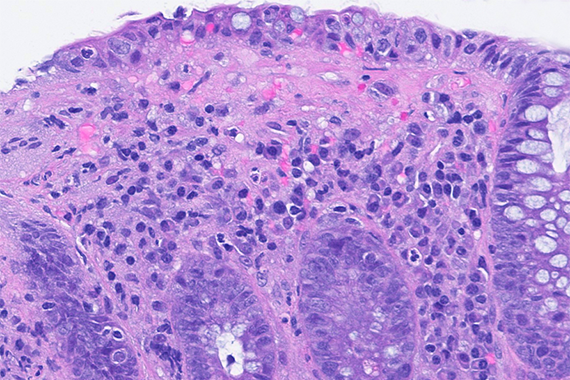
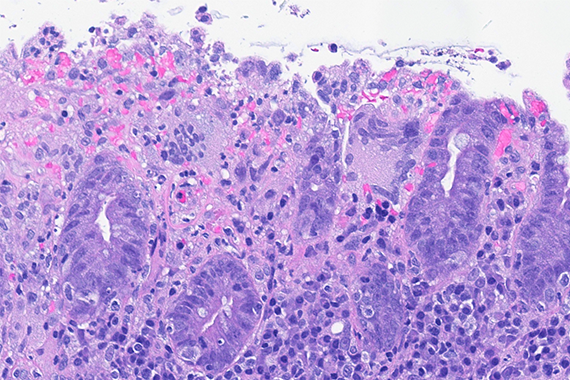
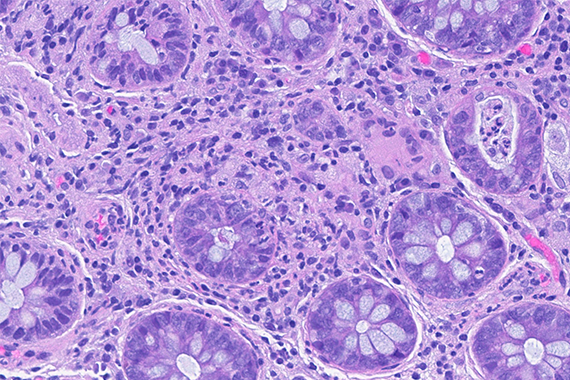
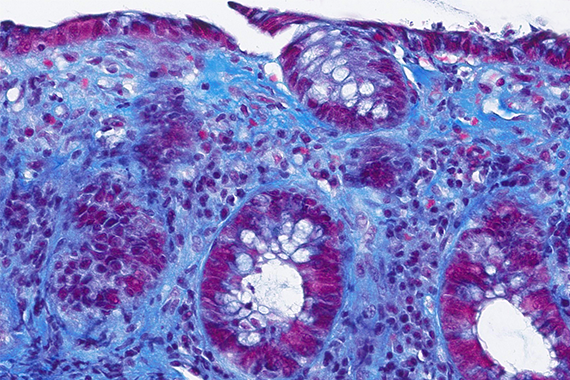
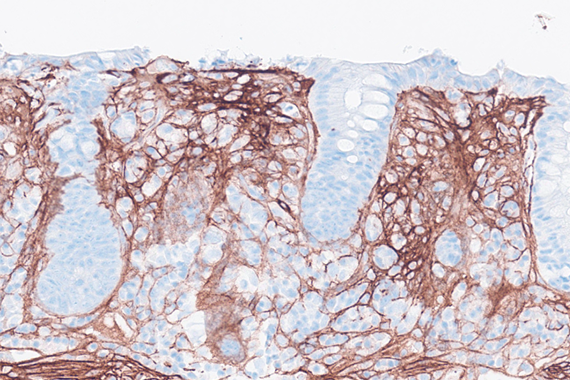
Histology of several colonic sites showed a thickened subepithelial collagen band (>10 μm), predominantly beneath the superficial epithelium but also surrounding the crypts (Panel A). Surface epithelial injury was also observed, with focal mucin depletion and detachment of superficial epithelial cells (Panel B). Lamina propria showed increased cellularity, with lymphocytic and plasmocytic infiltration, along with numerous giant cells (Panel C). There was no crypt architectural distortion. The collagen deposition was highlighted by Masson’s trichrome stain (Panel D) and strongly by tenascin immunohistochemistry (Panel E).
Collagenous colitis, together with lymphocytic colitis, falls under the clinicopathological umbrella term microscopic colitis. It predominantly affects older adults and shows a female predominance, particularly in collagenous colitis. The main symptom is chronic, non-bloody, watery diarrhea, while endoscopic findings are typically unremarkable. The pathogenesis is not yet fully understood but is considered multifactorial, likely involving dysregulated immune responses to luminal antigens, impaired intestinal barrier function and alterations in myofibroblast activity.
Due to its patchy distribution, multiple biopsies should be taken when microscopic colitis is suspected.
Histological variants of both collagenous and lymphocytic colitis have been described, including collagenous colitis with giant cells. In this variant, multinucleated giant cells are abundant and scattered throughout the lamina propria, with no apparent prognostic value.