Diagnostik- und Forschungszentrum

Microbiome research area

PI: Christine Moissl-Eichinger

Focus: The main aim is to explore the human microbiome (gut, mouth, skin, etc.) and its interactions with environmental microbiomes (e.g., interiors). Research projects encompass pregnancy and early childhood health, the nasal microbiome and sense of smell, skin and gut and the interaction of the microbiome with the human immune system. Chrstine Moissl-Eichinger is especially interested in unusual microorganisms that are difficult to detect—including archaea.  Though no pathogenic representative of these archaea is yet known, they are widespread in the environment—and also in the human body.

Networking: Thanks to Interactive Microbiome Research, the exploration of the microbiome in Graz is nationally and internationally visible. Within the Medical University of Graz, the Moissl-Eichinger working group supports clinical research in a variety of projects. In addition, the interuniversity BioTechMed initiative pools existing and new expertise in the exciting interdisciplinary field of microbiome research within the city of Graz.

Interactive Microbiome Research is well established within the Austrian Microbiome Initiative AMICI and collaborates with national and international partners worldwide.
Projects

Archaeome - immune system interactions

  • In this project, we want to understand why some archaea trigger strong immune responses, while others are barely noticed. To this end, we are investigating how differences in the cell walls of these microorganisms influence their uptake by immune cells and which receptors are involved in this process. We are also analyzing how archaea are processed inside cells after uptake, what role their symbiotic lifestyle with other microbes plays in this process, and whether this alters their immunogenic properties.
  • Time: 2026 – 2029
  • Funded by: FWF, Fonds zur Förderung der Wissenschaftlichen Forschung 
  • Funding program: WEAVE
  • Role: Co-PI
  • Project partner: Prof. Dr. Holger Heine, Borstel, Germany.

ARCH-METH – Archaeal keystone species in host microbiomes: Understanding and controlling Methanobrevibacter for Environmental and Health Benefits

  • The aim of this project is to better understand the central role of Methanobrevibacter in microbiome networks, with the goal to specifically manipulate microbiomes for human health and to reduce methane emission from ruminants. We will use an integrative approach, combining computational, experimental and in vivo studies. 
  • Time: 2026 - 2030
  • Funded by: European Commission
  • Funding program: ERC Advanced Grant
  • Role: PI

ARCTECH: Harnessing the potential of archaea – and training Europe’s next visionaries for an innovative and sustainable future

  • ARCTECH represents the first European training initiative on archaea, aiming to foster the next generation of visionaries in fundamental archaeal research and their application in biotechnology. The project will address key knowledge gaps and develop methods and technologies for archaeal research, which are needed to unleash the industrial potential that archaea hold.
  • In Graz, we are specifically working on the interaction of human-associated archaea with their surroundings, including surface and excreted molecules.
  • Time: 2024 - 2028
  • Funded by: Europäische Kommision
  • Funding program: Horizon MSCA
  • Role: Project partner
  • Project Partners: Tessa Quax, University of Groningen, The Netherlands; Sonja-Verena Albers, University of Freiburg, Germany; Bettina Siebers, University of Duisburg-Essen, Germany; Linda Dengler, Microbify, Germany; Pierre Türschmann, Interherence, Germany; Hanna Oksanen, University of Helsinki, Finland; Marco Moracci, University of Napels, Italy; Bertram Daum, University of Exeter, United Kingdom; 
  • Associated Partners: Martin Pilhofer, ETH Zürich, Switzerland; Kenneth Jensen, Novozymes, Denmark;

Cluster of Excellence: Microbiomes drive planetary health

  • The overarching scientific goal of the Cluster of Excellence “Microbiomes Drive Planetary Health” is to gain a deep understanding of the molecular, physiological, and ecological mechanisms that govern the composition and function of the microbiome across a wide range of highly relevant microbial ecosystems—from the human gut to soils to the deep sea—thereby linking microbes to environmental and human health, i.e., with the health of the planet.
  • In Graz, we are specifically working on the small intestine microbiome, with the goal to understand its composition and function in small intestinal bowel overgrowth and intestinal methanogen overgrowth.
  • Laufzeit: 2023 – 2028
  • Gefördert durch: FWF, Fonds zur Förderung der Wissenschaftlichen Forschung
  • Funding program: FWF Clusters of Excellence
  • Role: Co-PI, Co-director
  • Projektpartner: 8 institutions across Austria (University of Vienna (UNIVIE), Austrian Institute of Technology (AIT), Research Center for Molecular Medicine (CeMM), Institute of Science and Technology Austria (ISTA), Johannes Kepler University Linz (JKU), Medical University of Graz (MUG), Medical University of Vienna (MUW), Technical University of Vienna (TUW).

SFB Immuno-Metabolism

  • Macrophages are evolutionary ancient cells essential for tissue integrity, involved in both catabolic and anabolic reactions. Disruption of their function can lead to disease. Recent studies show that macrophages utilize various metabolic programs for specific functions in vitro, yet the role of metabolic signals in vivo remains complex and underexplored. Understanding macrophage immunometabolic functions is crucial for grasping how they maintain tissue integrity and contribute to disorders like obesity, type 2 diabetes, colitis, cancer, cachexia, and liver diseases. 
  • In Graz, we are specifically working on the interaction of macrophages with microbial communities, including archaea, in diverse disease contexts.
  • Time: 2021 - 2029
  • Funded by: FWF, Fonds zur Förderung der Wissenschaftlichen Forschung
  • Funding program: SFB
  • Role: Co-PI
  • Project partner: Gerda Egger; Med Uni Vienna; Arvand Haschemi, Med Uni Vienna; Anne Miller, Med Uni Vienna; Gernot Schabbauer, Med Uni Vienna; Martina Schweiger, Uni Graz; Omar Sharif, Med Uni Vienna; Thomas Weichhart, Med Uni Vienna;

Towards a comprehensive atlas of the human respiratory microbiome: taxonomic, genomic, and functional perspectives

  • This project aims to map the microbial community of the human respiratory tract in detail and to create a comprehensive atlas of involved microorganisms, and their patterns in disease and health.
  • Time: 2025 - 2026
  • Funded by: MEFOgraz 
  • Role: PI

Diagnostic and Research Institute of Hygiene, Microbiology and Environmental Medicine

Christine Moissl-Eichinger  
T: +43 316 385 73770
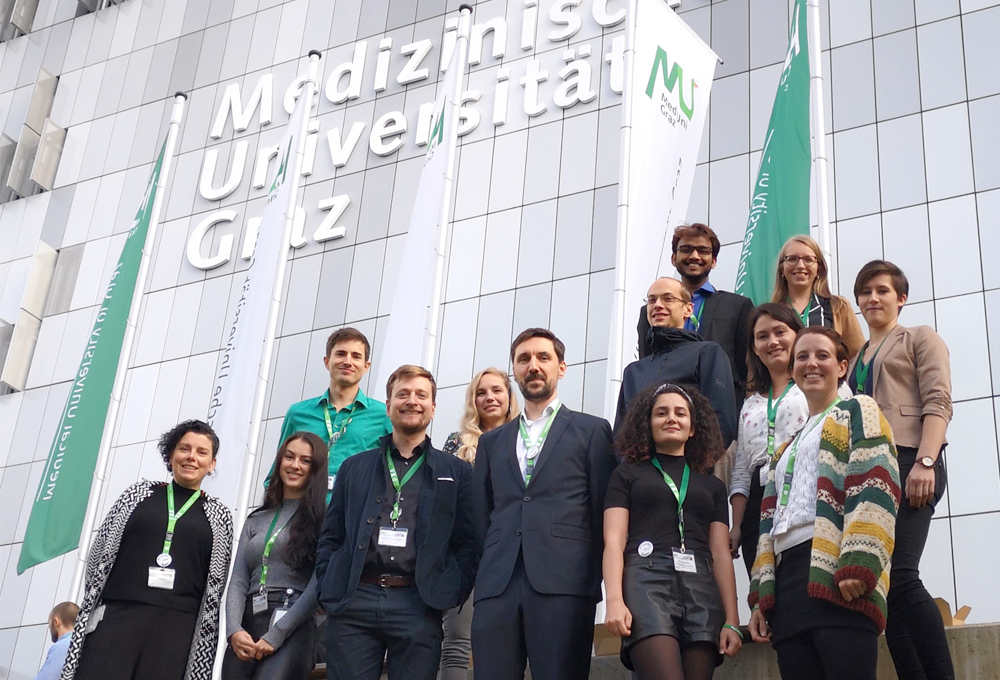
Forschungsteam um Christine Moissl-Eichinger

ORF-Reihe "Wissenswert"

Archaeen
Mikrobiomforschung
Mikrobiomforschung

Most recent publications and their importance

The crewed journey to Mars and its implications for the human microbiome

T Kuehnast, C Abbott, MR Pausan, DA Pearce, C Moissl-Eichinger, ...
Microbiome 10 (1), 1-14

In this commentary, we assess the knowledge on the  human and environmental microbiome relevant for the journey to Mars. 

A catalogue of 1,167 genomes from the human gut archaeome

CM Chibani, A Mahnert, G Borrel, A Almeida, A Werner, JF Brugère, ...
Nature microbiology 7 (1), 48-61

We describe the genomic wealth of the human gastrointestinal archaeome.