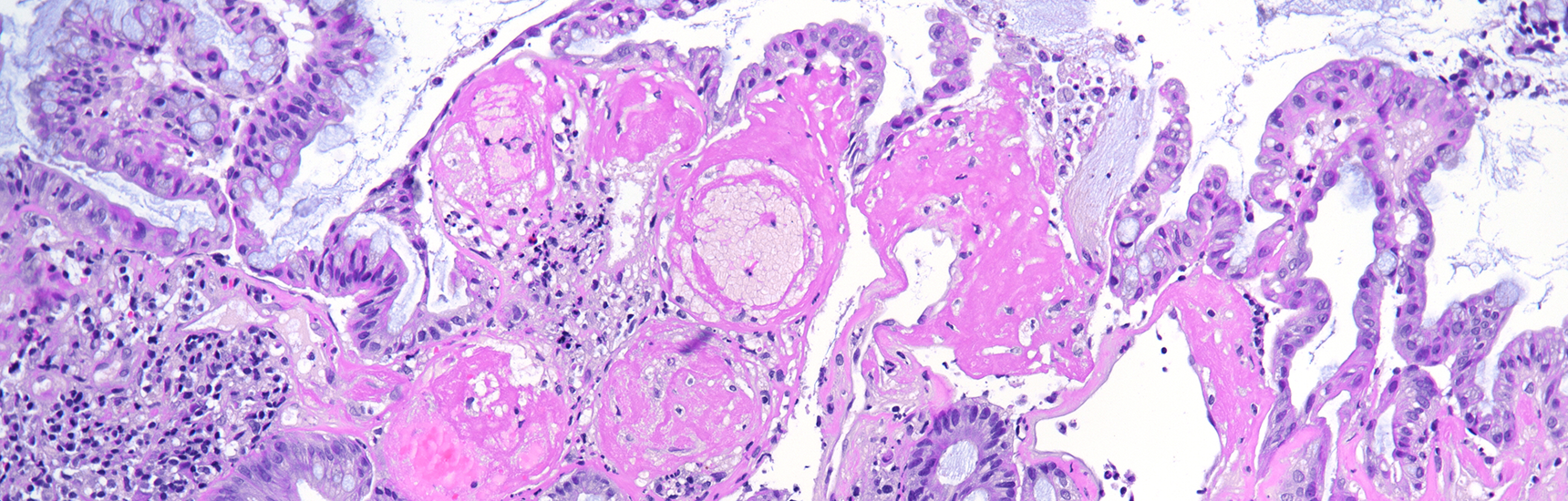
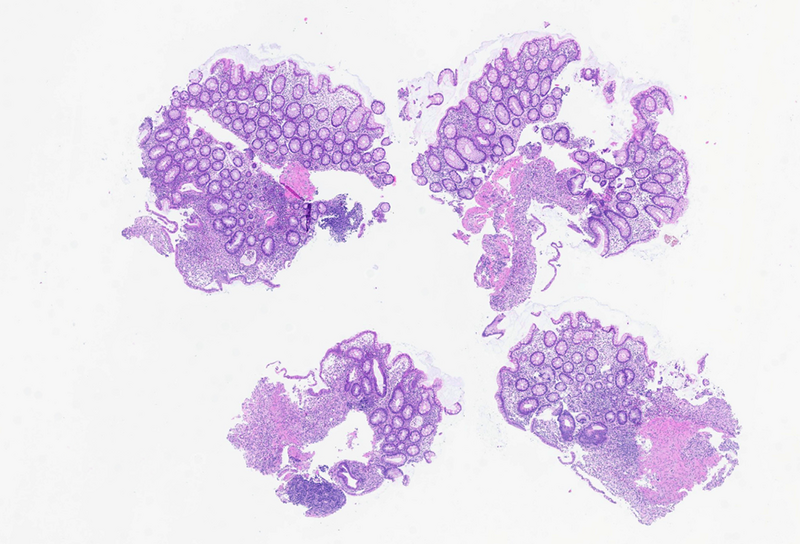
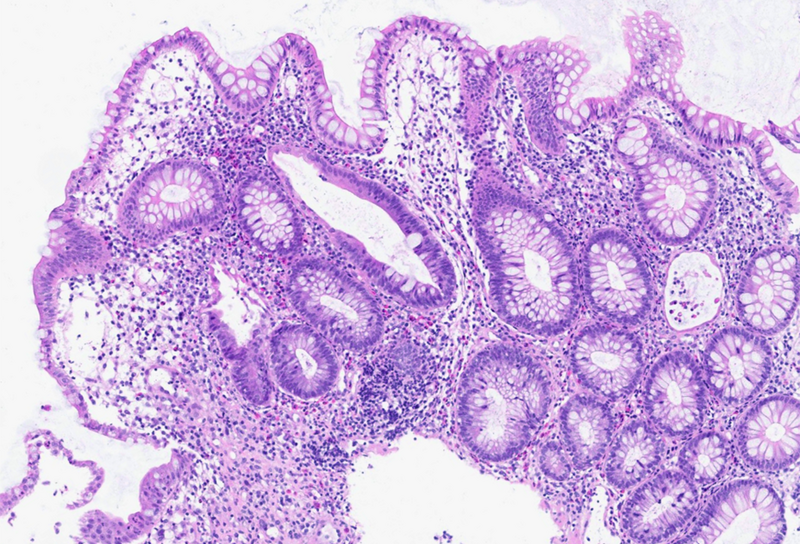
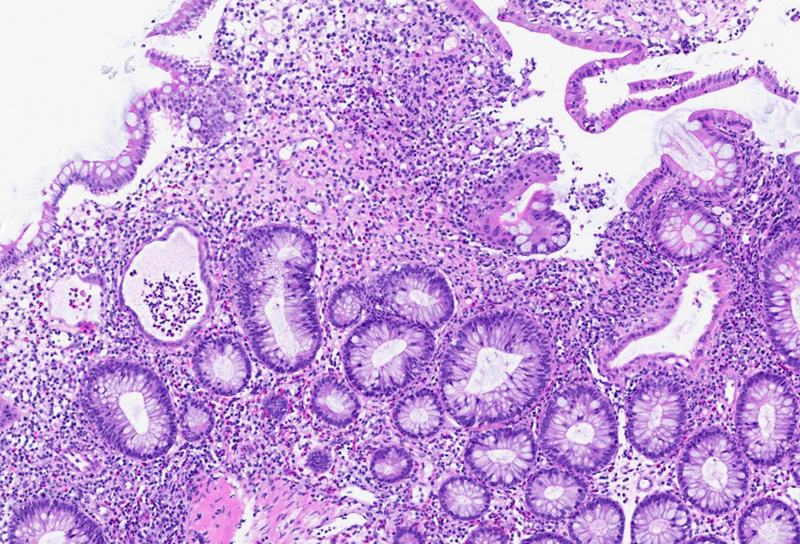
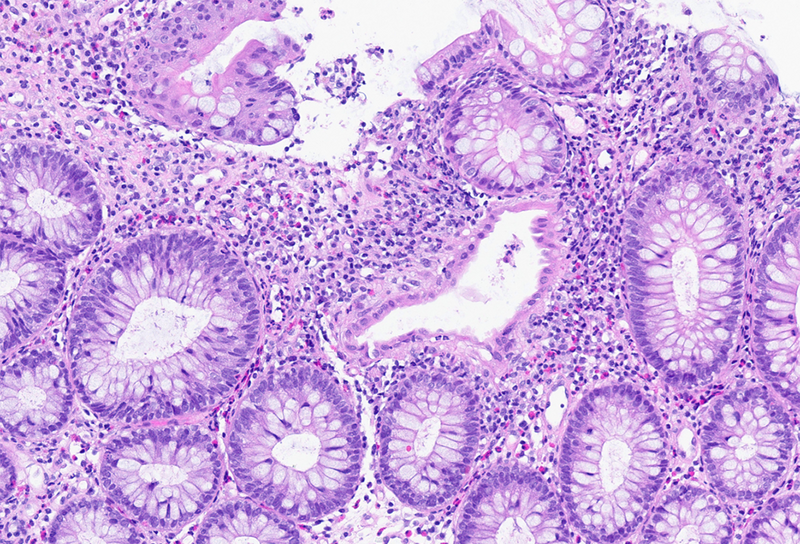
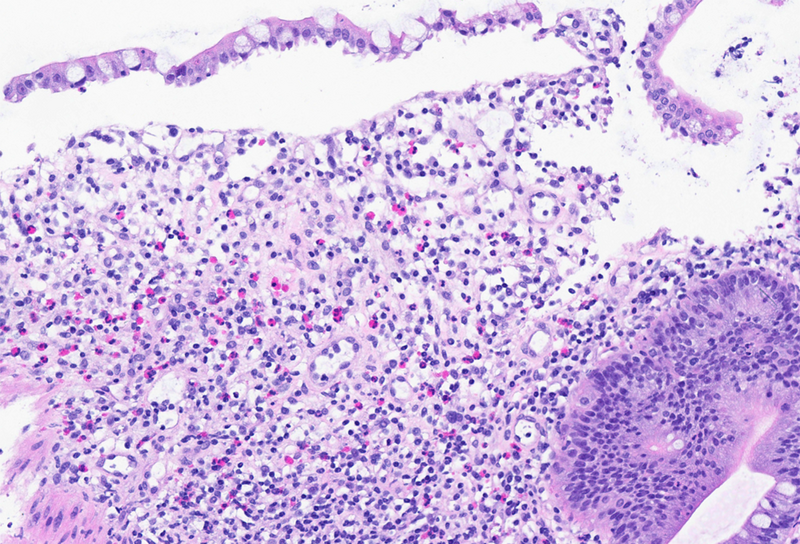
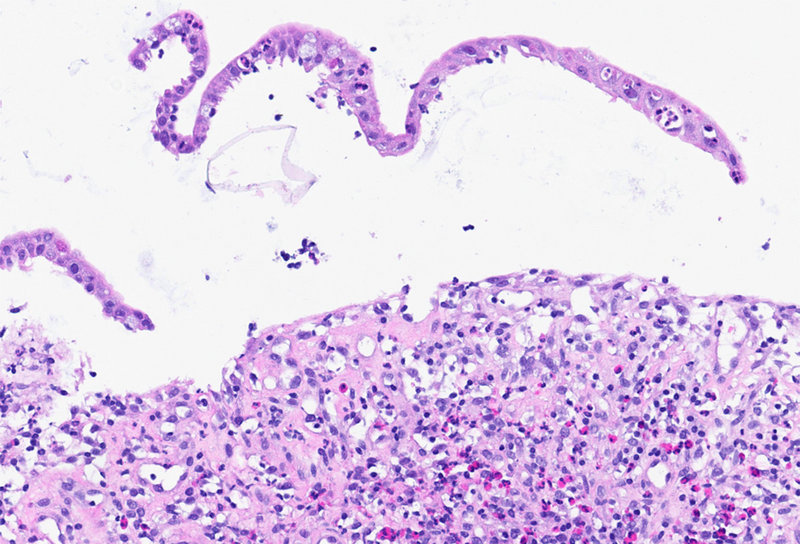
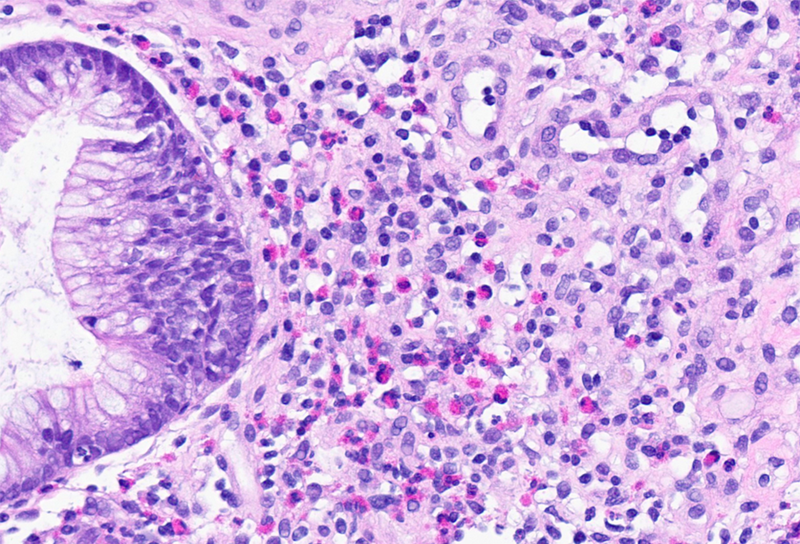
A 77-year-old female underwent colonoscopy for haematochezia. She had been diagnosed with lung cancer before treated with Nintedanib, and was also under therapy with Abatacept for chronic arthritis. Colonoscopy revealed left-sided ulcerous inflammation.
Histology showed discontinuous chronic inflammation. The mucosa contained foci of granulation tissue with crypt atrophy, as well as hyperplastic and moderately dystrophic changes. The inflammatory infiltrate consisted of lymphocytes and plasmacytes with basal plasmacytosis, accompanied by prominent eosinophilic infiltration. Activity was identified in the form of erosions with marked regenerative epithelial changes, crypt abscesses, and drop-out of crypts and crypts with attenuated, hyper eosinophilic cytoplasm. Mildly increased apoptotic bodies were also noted, in all producing a mixed inflammatory pattern with IBD- and Graft versus Host Disease-like changes (Panel A-H).
Drug-related colitis is a recognized complication of several systemic therapies and can mimic virtually any bowel pathology, including IBD.
Case reports and small series have linked nintedanib (a multi-tyrosine kinase inhibitor/antifibrotic drug) with an inflammatory colitis that may clinically and endoscopically resemble IBD, and histologically show features ranging from neutrophil-rich cryptitis, crypt abscesses, and mucosal erosions to collagenous-colitis–like changes or linear mucosal defects. These nintedanib-associated cases emphasize that drug toxicity can produce both active inflammatory damage (cryptitis/abscesses, erosions) and chronic reparative changes (crypt atrophy, distortion, increased apoptosis).
Similarly, abatacept (CTLA-4-Ig; an immune-modulating agent used in autoimmune diseases and sometimes encountered in oncology patients) has been reported to precipitate or unmask an ulcerative-colitis-like phenotype in several case reports, including presentations with moderate to severe colitis requiring therapy modification. As is known, ulcerative colitis occurs in approximately 0.5% of patients with rheumatoid arthritis, and current reports show that use of abatacept can lead to exacerbation of the disease. However, they also show that three out of four patients improved after discontinuation of therapy, while one achieved remission without relapse. This raises the possibility that true ulcerative colitis was not triggered at all, but rather that the findings represented drug-induced changes that clinically and histologically mimic IBD.
Drug-induced mucosal injury can closely mimic other entities such as infectious colitis, graft-versus-host disease, ischemic colitis, and IBD. A recent, broader review of drug-induced gut inflammation highlights typical pathological clues that favour a drug-related aetiology over idiopathic IBD: more prominent epithelial cell apoptosis, a focal or patchy distribution, and a mixture of acute (neutrophilic) and chronic (plasma-cell/lymphocytic) inflammation without the classic continuous crypt architectural distortion seen in long-standing IBD, along with brisk mucosal regeneration/granulation and drop-out crypts. Eosinophils are also often increased in drug reactions. In our case clusters of eosinophils were found alone without accompanying plasma cells, as would be typical for IBD.
Nevertheless, significant overlap exists, and no single morphologic feature is pathognomonic – clinic-pathological correlation (drug timing, symptom onset, endoscopy, and response to drug withdrawal) is essential for assessing causality.